Raw honey vs regular honey: what actually changes when honey is heated
Two jars sit next to each other. Same amber colour, same sweetness, same word on the label: honey. One costs three euros, the other fifteen. The difference isn't marketing — it's what happened between the hive and the shelf.
What raw honey actually means
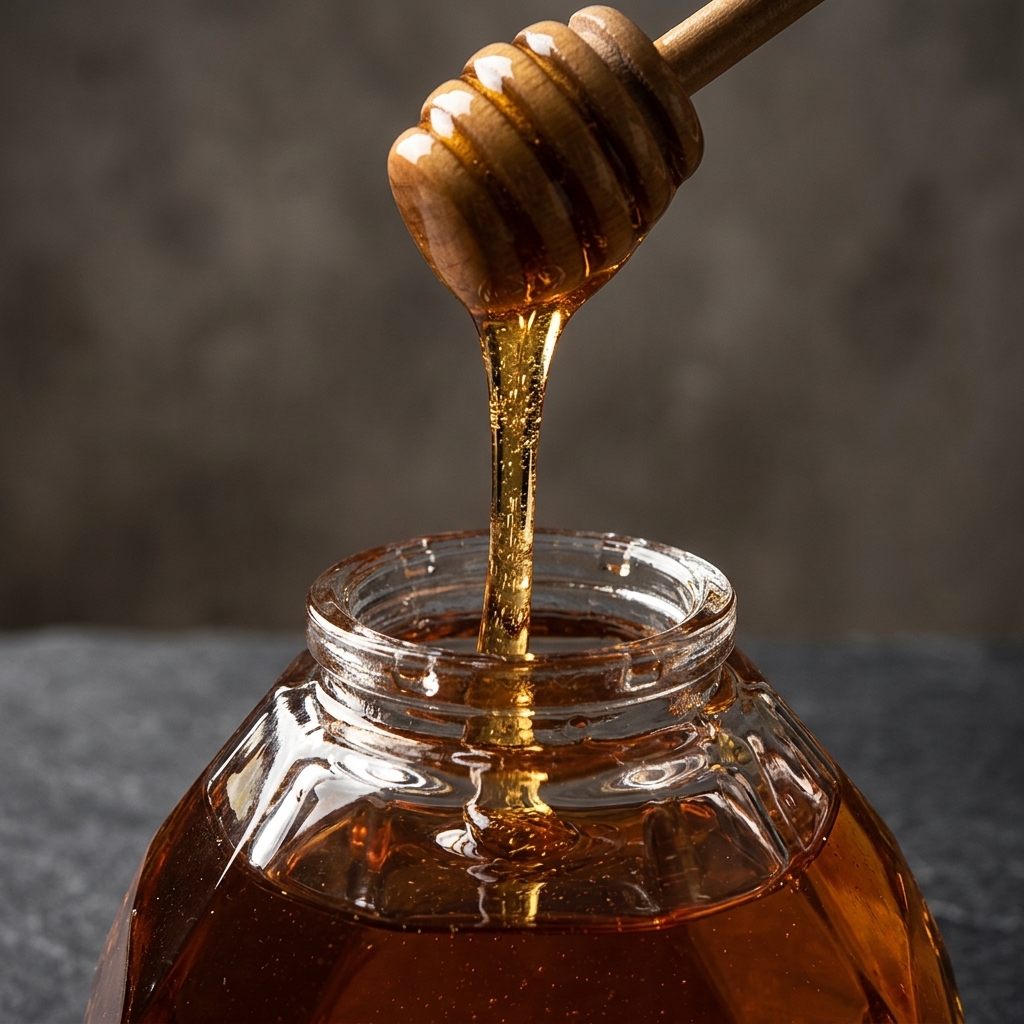
Raw honey is honey that has not been heated above the temperature of the hive (roughly 35 °C / 95 °F) and has not been filtered fine enough to strip out its pollen. It is extracted, gently strained to remove wax and bee parts, and jarred. That's it. Nothing added, nothing removed, nothing cooked.
Regular supermarket honey usually goes through two extra steps: pasteurisation and ultrafiltration. Both are done for the shelf, not for you.
Pasteurisation: heating honey to slow crystallisation
Pasteurised honey is heated to somewhere between 63 °C and 77 °C for a few minutes. The point is not food safety — honey is naturally antimicrobial and does not spoil. The point is cosmetic: heat dissolves the tiny sugar crystals that would otherwise seed crystallisation in the jar. Pasteurised honey stays liquid and clear for longer, which makes it easier to sell.
The cost is chemistry. Heating drives up HMF (hydroxymethylfurfural), a marker of thermal damage that regulators cap at 40 mg/kg for most honeys. It also degrades diastase, an enzyme bees add during ripening that is used as a freshness indicator. Aromatic compounds — the volatile molecules that make a good acacia honey smell like acacia — start to evaporate around 40 °C.
Ultrafiltration: removing pollen for a clearer jar
Ultrafiltration pushes honey through filters fine enough to strip out pollen grains. Producers do this to prevent haze and delay crystallisation even further. The side effect is that the honey loses its geographic fingerprint: without pollen, a laboratory cannot verify where it came from.
That matters, because honey is one of the most adulterated foods in the world. A 2023 EU coordinated action found that 46 % of the honey samples imported into the EU were suspected of being adulterated with cheap sugar syrups. Ultrafiltered honey makes that fraud harder to catch.
Blending: why the label says one country and the honey says another
Most jars on a supermarket shelf are blends. The label often reads "blend of EU and non-EU honeys" — a phrase that can hide a jar mixed from a dozen sources across three continents. Blending averages out flavour, colour and origin. It also averages out accountability: if something is wrong with the batch, no single beekeeper is responsible.
Single-origin raw honey is the opposite. One region, one harvest, one beekeeper. If you don't like it, you know who made it. If you love it, you know how to find it again.
How to tell the difference in the jar
- Raw honey crystallises over months. If a honey stays perfectly liquid for a year at room temperature, it has almost certainly been heated.
- Raw honey is rarely perfectly clear. A slight haze is pollen, wax micro-particles and air — signs of minimal processing.
- Read the label. "Raw", "unpasteurised" and "unfiltered" are meaningful terms. "Pure" and "natural" are not — they are unregulated marketing words.
- Look for a country of origin, a harvest date and a batch number. If any of the three is missing, ask why.
Why we bottle NECTICO raw
Every batch of NECTICO is raw, single-origin, and laboratory tested for authenticity, moisture, HMF, diastase and residues before it is jarred. We document the beekeeper, the region and the harvest, and we print the batch number on every jar so you can trace it back yourself. It is more work than blending, and it produces a honey that tastes like the place it came from — which is the point.